

The Right Stuff
For many students, college is defined by late-night study sessions, term papers and cheering on their sports team. But for some, the college experience also means tackling challenges beyond hushed classrooms and rowdy arenas.
As you'll see in the following pages, some students spend their days designing medical devices, shadowing cancer doctors or identifying the obstacles to healthier eating. Others are scaling the Himalayas to interview tour guides and descending into lava caves to collect microbes.
Whatever their particular blend of impact and adventure, research is the common thread.
At research-intensive universities like the George Washington University, students don’t just observe research from the sidelines. They roll up their sleeves—or lace up their hiking boots—and become active participants in discovery, innovation and creation.
Sometimes that journey starts with a cold call to a professor, asking to join their lab. Sometimes a support office, funding opportunity or other campus resource provides the initial stepping stones to a research project.
However the journey begins, students emerge from the experience transformed.
Transformed because they helped advance science and create new knowledge.
Transformed because they learned to tackle complex questions with rigor and confidence.
Transformed because their new skills position them for success, whether they’re bound for graduate school or the job market.
The five student researchers featured here share, in their own words, a small part of their journey and what motivates and excites them about their work.

Pia Sen
Pia Sen is a fifth-year Ph.D. candidate in biological sciences at the Columbian College of Arts and Sciences. She studies extremophiles—microbes that live in extreme environments. She conducts fieldwork with Assistant Professor of Biology Jimmy Saw and is a research assistant in Professor Keith Crandall’s bioinformatics lab at the Milken Institute School of Public Health. A Texas native, her accomplishments include seven NASA internships, a Lewis and Clark Fund for Exploration and Field Research grant from the American Philosophical Society and first-author credit on a recent study in “Microbiology Spectrum.”
“My laboratories are the hot springs of the Western U.S. deserts and the volcanoes of Hawai‘i.”
Sen measuring iron concentrations in the water at a hot spring in Utah.


If I stopped to think about what I’m doing, if I let myself be scared, I probably wouldn’t be here.
I wouldn’t be crawling on my belly into a lava cave on the side of a Hawaiian volcano with only a headlamp guiding me through the darkness.
I wouldn’t be leaning over the edge of a 200-foot deep fissure, staring down into a crack in the Earth.
And I wouldn’t spend hours slashing through thickets with a machete, hiking toward a steam vent that blows 160-degree volcanic gas.
I’m a microbiologist—and I go where the microbes are. Microbes are tiny living organisms. They’re in our gut, in our skin, in plants and oceans. If life exists elsewhere in the universe, it may be microbial. I study extremophiles, microbes that withstand harsh environments. My laboratories are the hot springs of the Western U.S. deserts and the volcanoes of Hawaiʻi.
Hunting for microbes wasn’t always my career plan. I was never a STEM kid. My mom is a pianist, and I thought I’d become a musician or a writer.
I got hooked on extremophiles from watching “The Martian.” I wanted to experience that firsthand discovery, finding microbes where most life can’t survive. I love fieldwork—the prospect of sharing knowledge with the environment around you. It can be dangerous. I’ve almost stepped into hot springs, and I’m a magnet for snake bites. But it’s addictive too. When I’m in the lab, I think about getting back into the field.
Near Christmas 2024, I took my second research trip to Hawaiʻi’s Big Island. From the plane, I could feel the pull of Kīlauea, the 300,000-year-old active volcano that powers the entire island. When we search for microbes, we rely heavily on local knowledge. Lift a rock on the side of the highway and a gust of steam might escape. Fissure cracks can open in people’s backyards.
On day one, our research team—Professor Jimmy Saw, a postdoctoral researcher and me and a fellow graduate student—suited up in our “uniform” of REI hiking boots and fluorescent vests that make us look like crossing guards. As we piled into a Land Rover, my Taylor Swift playlist annoying my colleagues, our tires crunched over the brittle threads of volcanic glass called Pele’s hair. When the terrain became too unstable, we traveled on foot, cutting through shrubs with machetes. Even at Christmas, the humidity was almost too much to bear. Fieldwork is incredibly physical. I’m glad I did gymnastics most of my life!
The microbes grow on rocks around steam vents and fissures. They form thick biofilms that look like “flubber” from the Disney movies. At a fissure, I lay on my stomach and reached over the edge to scoop samples—a sheer drop below me roughly the height of two Science and Engineering Halls. “This is the coolest thing ever,” I thought. “I can’t believe this is my life!”
On our hike to Kazumora Cave, a 40-mile tunnel hollowed out by molten lava, our local guide pointed to a dead possum on the rocks. “If you’re not careful in there,” he said, “that’s gonna be you.” That might have been the time to turn back—but, for me, curiosity always outweighs fear.
As we descend into the cave, our headlights shine on silvery-red basaltic walls, wet with condensation. It feels like I’m looking into the past. Just days later, Kīlauea erupted. From our base at Hawaiʻi Volcanoes National Park, we heard the lava hissing.
Our discoveries have implications for everything from engineering to agriculture to climate solutions. We found two new orders of microbial viruses, and I became lead author on my first paper. But back at GW, analyzing samples late into the night, I was already planning my next destination: the Antarctic Dry Valleys. Cold, windswept and blasted by UV radiation, it’s as close to Mars as I’ll ever get.
My mom is not a huge fan of my fieldwork. She made me promise never to go underwater cave diving. That sounds dangerous—even to me. But I’m learning never to say never.
– As told to John DiConsiglio

Paul Gomez
Paul Gael Gomez is a sophomore at GW’s Milken Institute School of Public Health on the pre-med track and a member of the University Honors Program. He works in the Food Environments, Diet Disparities and Disease Prevention Lab, led by Associate Professor of Exercise and Nutrition Sciences Karina Lora, where he is part of a team studying the food and physical activity behaviors of Central American men, including factors supporting or hindering their adherence to nutritional and exercise guidelines that can help prevent cancer. At the Milken Institute SPH’s 2026 Research Day, he won a first-place Climate and Health Research Prize in the undergraduate category for his work examining understanding of the public health impacts of data centers.

“What you eat
has a huge effect on your health.
Food is medicine.”
Gomez with his Climate and Health Research award.
My brain works in colors.
When I’m speaking to a research participant or looking at an interview transcript—where my goal is to figure out what motivates someone to eat healthy and exercise, or what keeps them from doing that—the things they say seem to light up in different colors.
For example, the color blue is for certain facilitators to healthy eating. If someone says, “There’s a grocery store I can walk to in my neighborhood,” that's a very strong blue: It’s relatively easy for them to get fresh produce or whole foods. If there’s no accessible grocery store, that’s grey, which is for barriers to healthy eating.
The color yellow is for healthy living motivators. Statements about children and spouses—especially spouses—tend to light up the strongest yellow. Someone might say his wife loves Zumba or likes cooking healthy meals for the family. That’s a big, bright yellow for me.
Family is interesting, though, because family members can be both strong facilitators and strong barriers to a healthy lifestyle.
If your children like to run around and exercise, maybe you get exercise by running around after them. On the other hand, maybe your kids love sugary cereal, so that’s all you have in the house, or you work all day and the easiest way to spend time with your kid is taking her to McDonald’s. Or maybe you live with your grandmother who makes a lot of calorically dense traditional foods.
The absence of family can also be a factor. People will tell me things like, "When I first arrived in the U.S., I was alone, so I ate a lot of fast food.” It's interesting to see how different factors intersect and how they might line up to make a person more vulnerable to chronic diseases like cancer or hypertension.
But seeing responses in different colors is just how my brain works (and I use them on spreadsheets tracking our results). For statistical analysis, we condense participants’ qualitative responses down to keywords, group the keywords into themes and turn those themes into statements.
Then we follow up with those same participants, give them a survey card and ask them to rate how strongly they’d agree with statements like, “My spouse motivates me to eat healthy.” It’s important never to assume we know what participants are thinking; we always make sure they tell us in their own voices.
What you eat has a huge effect on your health. Food is medicine. I don’t mean buying some commercial powder to get more protein—I mean getting balanced nutrition from the raw basics that the creator or whatever’s up there gave to us: vegetables, fruits, grains.
Once we identify why people do or don’t eat healthy and exercise, the next step is to design tailored interventions that meet people where they are. If a doctor or a public health professional encourages you to do something for your health, but what they’re prescribing is not reality-based, you won’t do it.
Those of us who do this research and think about these questions daily sometimes make assumptions that everyone knows what a healthy lifestyle looks like and why it’s important. But then I’m talking to a father who’s an immigrant, who works all the time and barely has time to eat. Why would he know what lifestyle choices help prevent colon cancer? A lot of men we interviewed don’t even know what the colon is. So we really have to start with education.
My first meeting with Dr. Lora was amazing. We were speaking Spanish the whole time. A lot of her research focuses on Hispanic men, and that spoke to me, of course, because I'm a Hispanic man. I see myself in these participants.
I love that we don't only look at cells under a microscope. If a person has cancer or another chronic condition, it’s not just about the disease; it's about the person. These are fathers, sons, tíos—uncles. At the end of the day, it’s their life. They’re the ones fighting this disease or dealing with this condition. What can help them? What gets in their way?
A cell is just a fraction of a whole person. It’s like a single drop of color in a bucket of paint.
– As told to Ruth Steinhardt
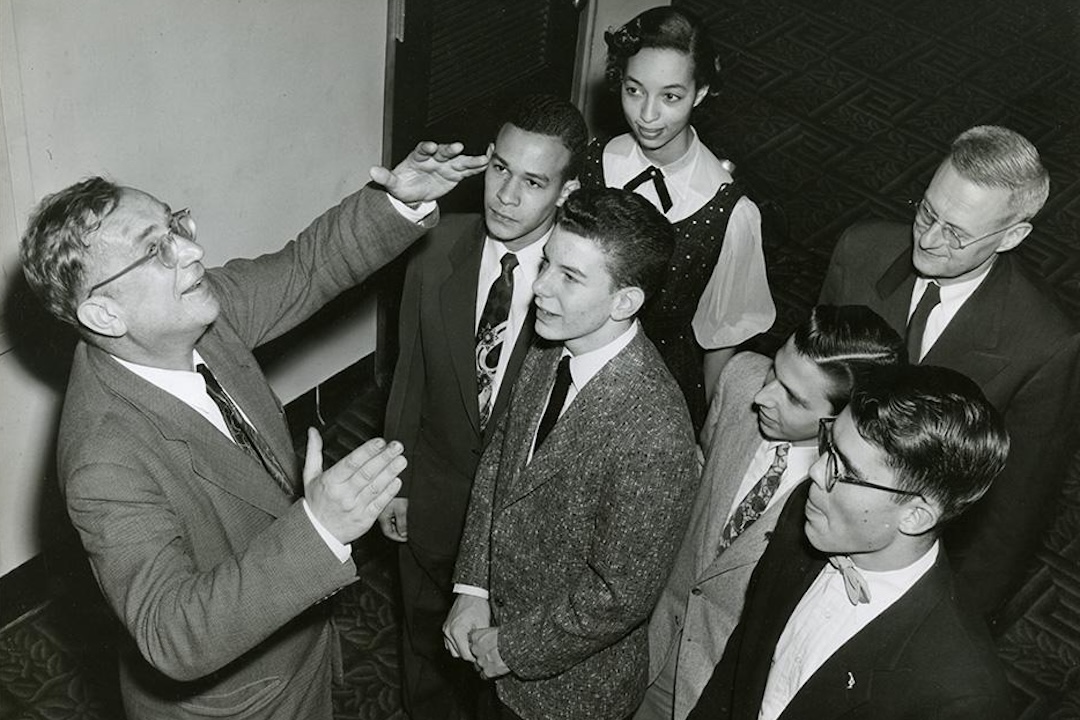
Physicist George Gamow (left, with GW students) first devised the Big Bang theory at Corcoran Hall.
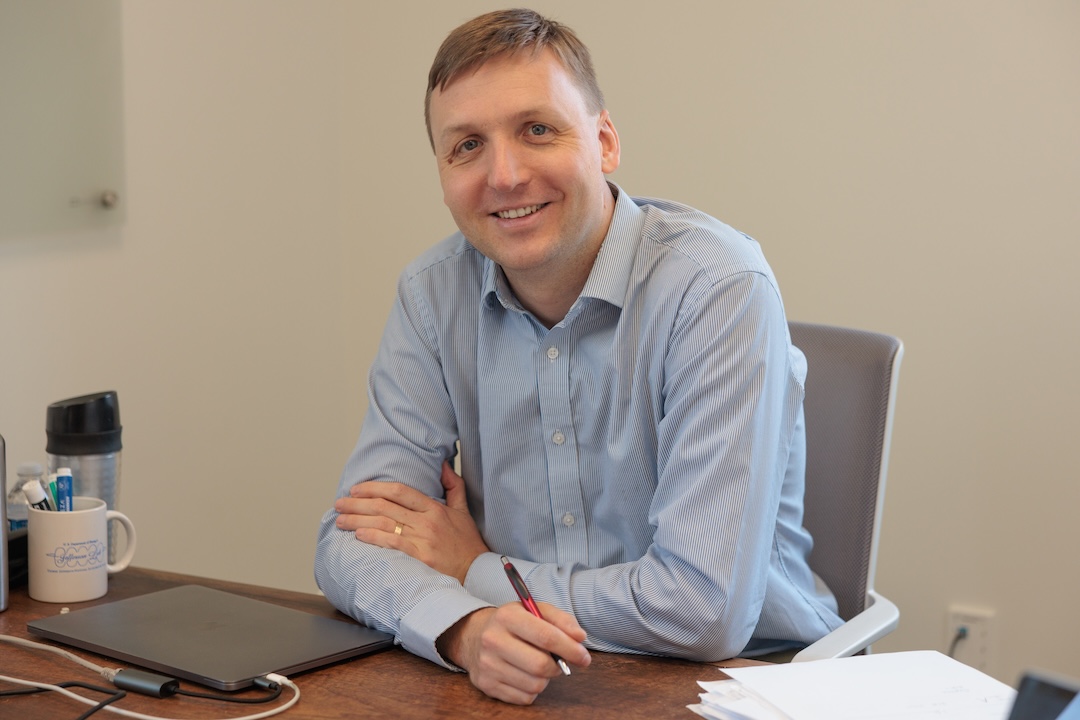
Axel Schmidt, seen here at the Edward Teller desk, co-leads the GW Jefferson Lab Group.
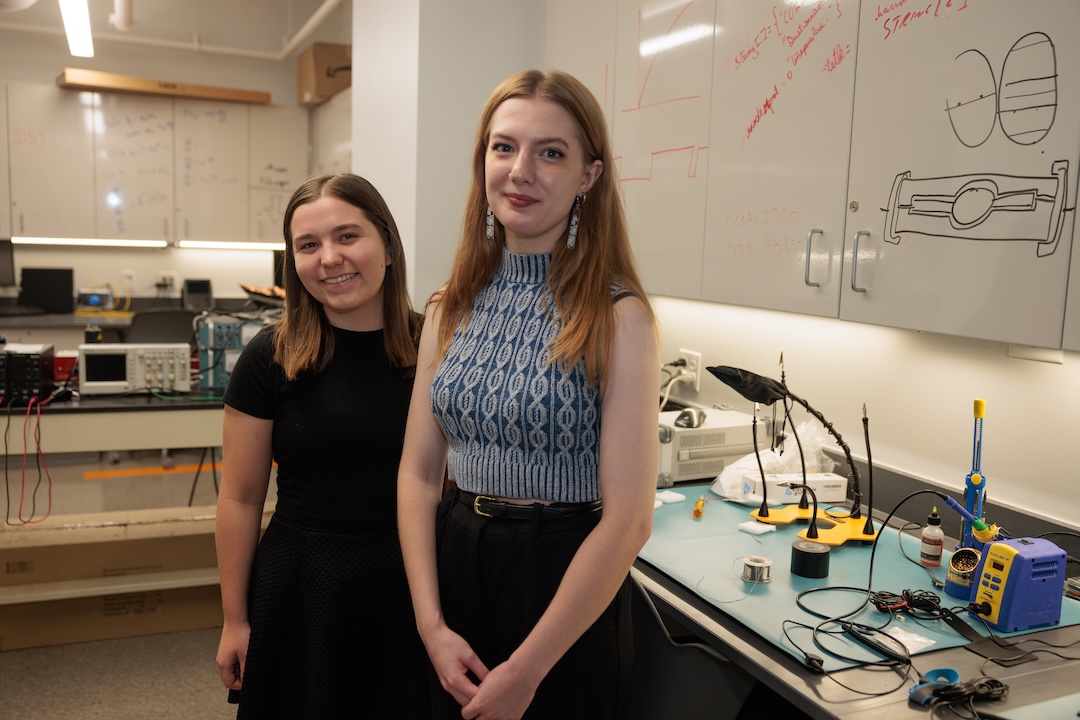
Physics students Quinn Stefan (left) and Olivia Nippe-Jeakins, president of the GW Chapter of Physicists of Underrepresented Genders.
The lineage of department nuclear experimentalists stretches from Gamow and Teller to Professor Emeritus William J. Briscoe, who first pioneered the GW-JLab partnership. Today, Schmidt leads the GW Jefferson Lab Group with Research Professor Igor Strakovsky and a team of postdocs, graduate and undergraduate researchers.
Behind the scenes, GW physics theorists like Harold Grieshammer, Michael Doering and Andrei Afanasev run the numbers that make the lab-and-laser experiments possible. “It’s all intertwined—there’s a synergy,” van der Horst said. “In our nuclear group, the theorists and the experimentalists don’t live in separate worlds. They are always talking to each other.”
Likewise, students benefit from the collaborative overlap. As an astronomy and astrophysics major, rising senior Olivia Nippe-Jeakins is drawn more to black holes than quarks—and never expected one of her research opportunities to be in Schmidt’s nuclear physics team. But among his JLab experiments, Schmidt examines a phenomenon called short-range correlations, where protons and neutrons are so close together that they influence each other’s momentum. That same reaction also takes place in the core of neutron stars—fittingly for Nippe-Jeakins’ research focus.
“We can’t bring a neutron star to Earth. This is as close as we’re going to get,” Nippe-Jeakins said. “The tiniest things in the universe and the biggest turn out to have similar characteristics. I love that I can look at it from both extremes.”
The Big Toys
From the outside, JLab looks more like an anonymous office park than an epicenter of particle research. There’s little indication that beneath the L-shaped complex off I-64 lies a subterranean hangar with accelerators, detectors and lasers —the “big toys,” as Schmidt calls them.
Once inside the experimental hall, researchers flash their badges at the security gate and fasten their radiation-measuring dosimeters. Twenty-five feet below them, an underground tunnel winds its way toward a racetrack-shaped course.
That’s the Continuous Electron Beam Accelerator Facility, one of the world’s most sophisticated particle accelerators. Like scientific stock cars, clusters of electrons accelerate around the track for nearly a mile, gaining energy with each lap. As magnets direct them around the arcs, the particles hit close to light speed and reach energies of up to 12 billion electron volts.
After five laps, the turbocharged electrons become a thin, focused beam like a microscopic laser pointer. Encased in a pipe, the beam fires down the JLab halls toward a target, which, depending on the experiment, could be elements like liquid hydrogen, deuterium or carbon. When the beam hits its target, the crash sends particles flying in different directions. A surrounding network of detectors capture data from the scattered particles and relay it to the counting house above. Across the rows of monitors, scientists and students reconstruct the subatomic collisions like police reviewing security footage of a car accident.
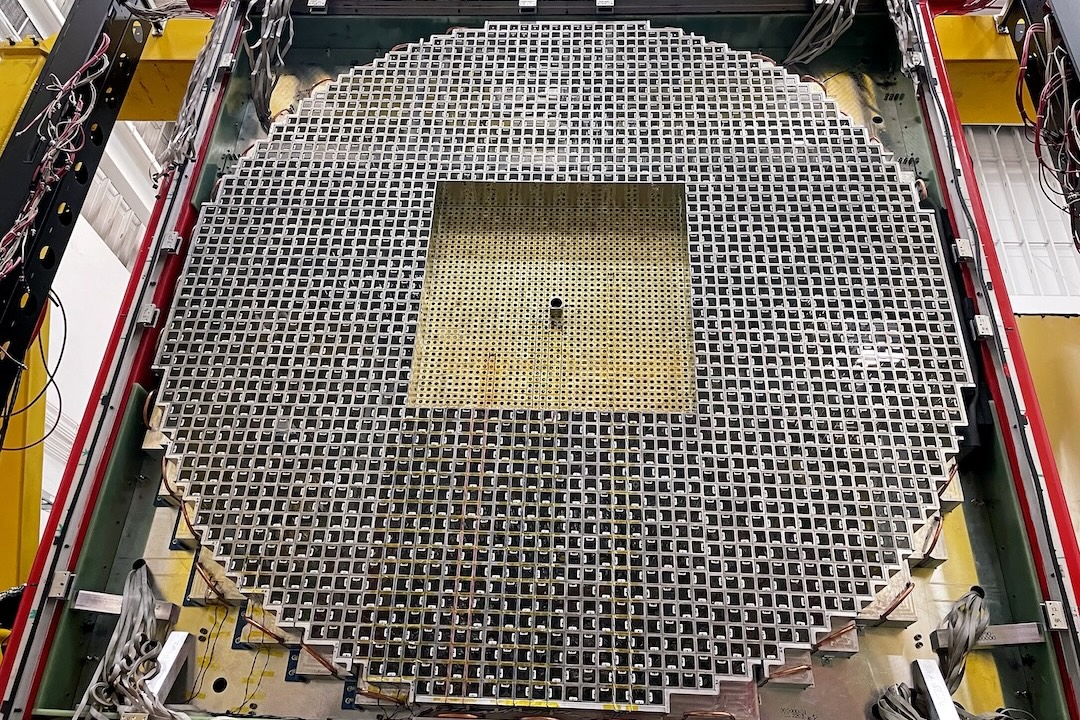
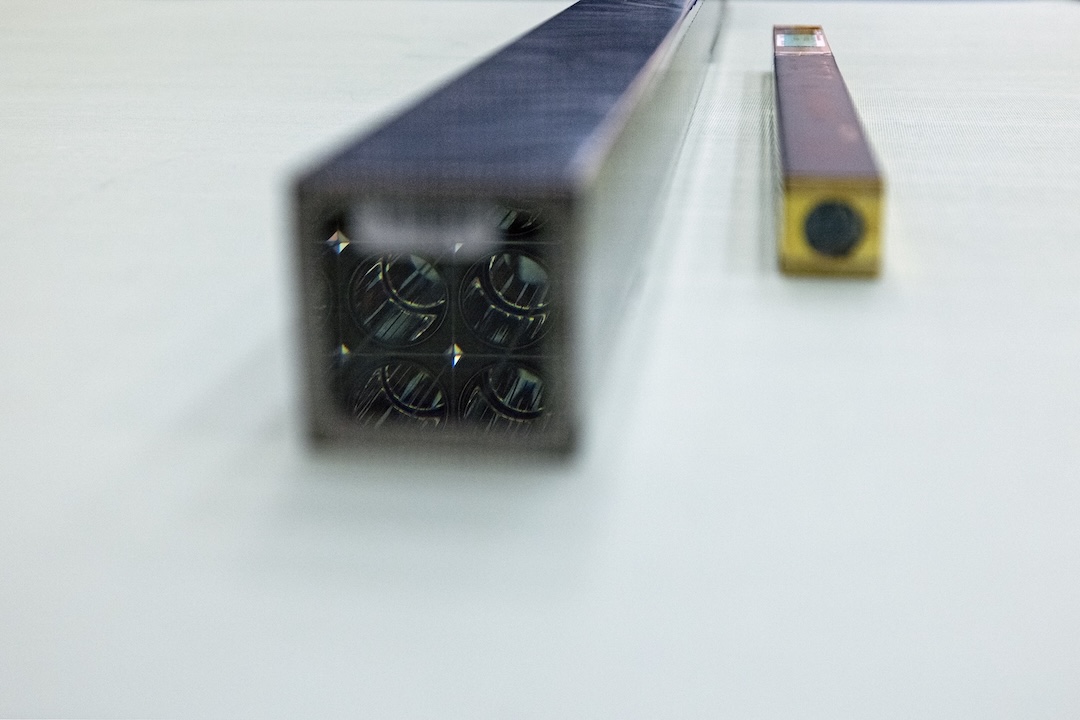
The forward calorimeter is the main detector used for the GlueX experiment. The detector consists of larger bricks made of lead glass and smaller bricks made of lead tungstate crystal that convert particle energy into a flashes of light. (Credit: Jefferson Lab)
In his JLab work, Schmidt manipulates his beam more like a precision “sharpshooter,” he said, than a reckless driver. His work often involves firing an electron beam through a thin wafer of diamond which pulls out energy into a beam of gamma rays—or photons. Photons don’t carry an electric charge and, unlike electrons, their energy can be fully absorbed by the proton or neutron they hit.
In one of his primary experiments, dubbed GlueX, Schmidt studies the forces that hold—“glue”—matter together. The GlueX team searches for traces of ephemeral unstable particles, many of which contain excited configurations of quarks and gluons. The photon beam hits a liquid hydrogen target and sets off a spray of particles whose scattering angle could potentially map the first-ever comprehensive diagram of strong force interactions.
“Our overarching goal is to learn the rules of the universe that would help us manipulate energy at densities vastly exceeding chemical or even nuclear power,” Schmidt said. “The new capabilities of our accelerators, experiments and detectors are giving us multidimensional information that is so advanced it’s like going from an X-ray to a CAT scan.”
Collision Course
To understand what matter is made of and the forces that shape our physical universe, physicists use accelerators to smash subatomic particles into each other at very high speeds, recreating the conditions of the early universe. At the Jefferson Lab's Continuous Electron Beam Accelerator Facility (illustrated here), GW faculty and students are smashing photons into different elements to investigate the forces that "glue" matter together as part of an experiment called GlueX.

Electrons are injected into a mile-long accelerator.

Guided by powerful magnets, the electrons loop around the accelerator until they reach close to the speed of light.

An electron beam fires through a thin diamond wafer, which pulls out energy into a beam of gamma rays–or photons.

The photon beam collides with a liquid helium* target inside of a large magnet, scattering different particles picked up by detectors.
* The photon beam can collide with a variety of targets, from liquid helium or hydrogen to solid graphite wafers.

Data from the detectors is transmitted to scientists in the counting house, who will reconstruct what happened at the moment of impact.
The Proton Puzzle
Across the Atlantic at PSI, Downie’s lower-voltage accelerators and beams aren’t buried in an underground bunker. They’re housed in a Swiss village 40 minutes outside of Zurich. Inside a barn-like structure across the Aare River, she and her students and colleagues—including Emeritus Professor Briscoe and Professor of Physics Andrei Afanasev—are part of an international partnership solving a mystery at the center of the proton.
A cornerstone of centuries of science, the positively charged proton is too small to be measured directly. Instead, physicists typically use the electron scattering technique: firing a beam of negatively charged electrons at a hydrogen atom and measuring the scattering angle as the individual electrons deflect off the nuclei’s lone proton. Another method involves measuring the energy levels of the electron in a hydrogen atom in a process known as spectroscopy.
In 2010, scientists at PSI, attempting to fine-tune their measurements, replaced the electron in the hydrogen atom with a muon—a nearly identical particle that’s 200 times more massive—and performed a spectroscopy measurement. Their results shook up the physics world. The proton, they determined, was smaller than long believed—by a trillionth the width of a poppy seed.
That infinitesimally tiny degree sent scientists “running in circles,” Downie said, to figure out why the proton seemed to shrink.
“The proton makes up about 50 percent of all observable matter and we aren’t sure how large it is,” Downie said.
In 2012, Downie and her colleagues joined the MUon proton Scattering Experiment (MUSE) Collaboration to reconcile the measurement. The project harnesses PSI’s proton accelerator to produce what Downie calls a “messy” particle-mixed beam. More like the car-crash approach than the laser pinpointing method, the beam bounces particles off the single proton inside a hydrogen atom—while detectors measure the scattering angles to estimate the proton’s true size.
“It feels like I’m on the forefront of this very fundamental research from the experimental side,” said Rachel Ratvasky, M.S. ’24, a fourth-year Ph.D. candidate who has worked as a research assistant on MUSE for the last three years. “I’ve been exposed to new areas of physics that I didn’t even know existed.”
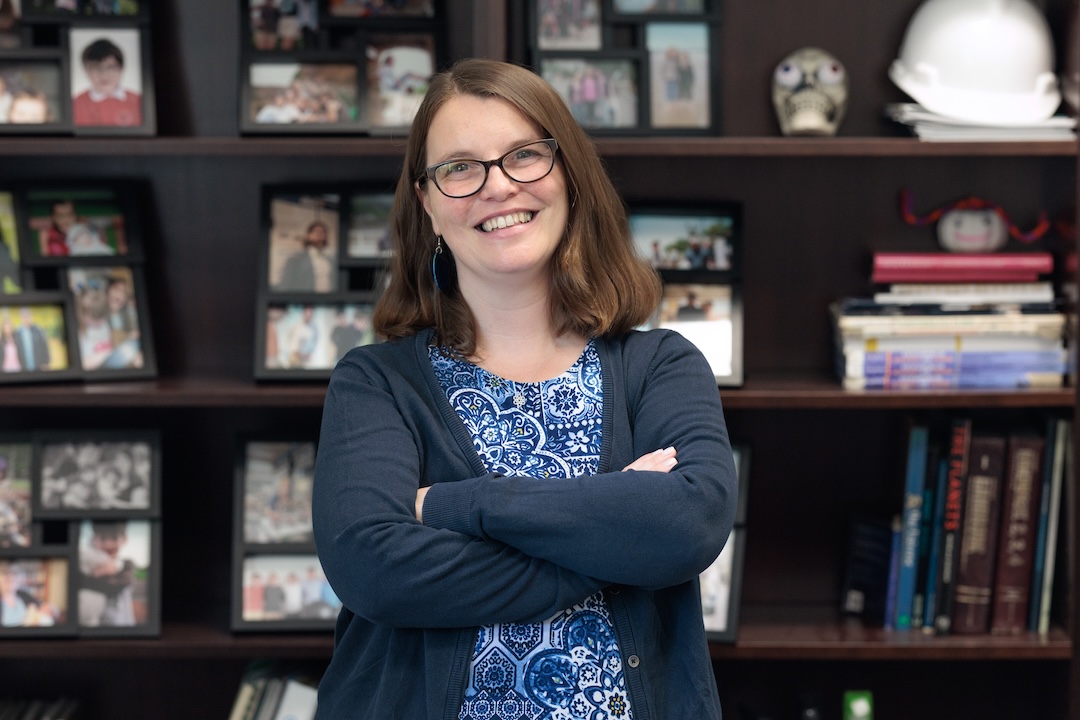
Professor of Physics Evangeline Downie is part of an international team using accelerators and lasers to measure the size of the proton.
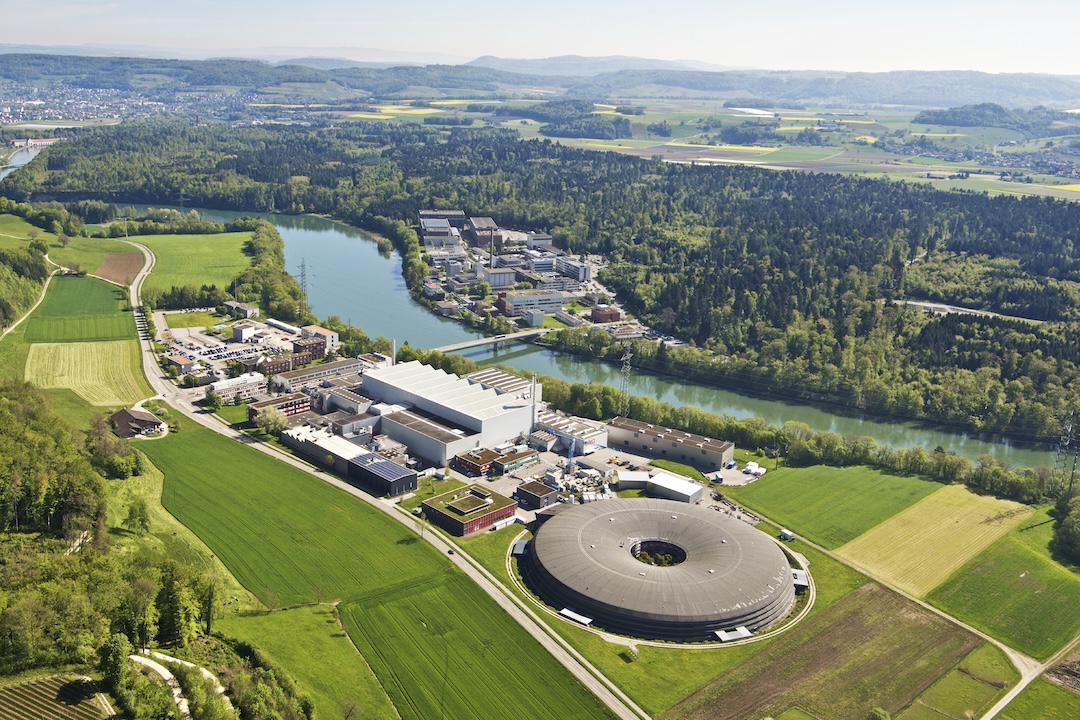
The Paul Scherrer Institute in Villigen, Switzerland, where Downie is part of the MUon proton Scattering Experiment (MUSE) Collaboration.
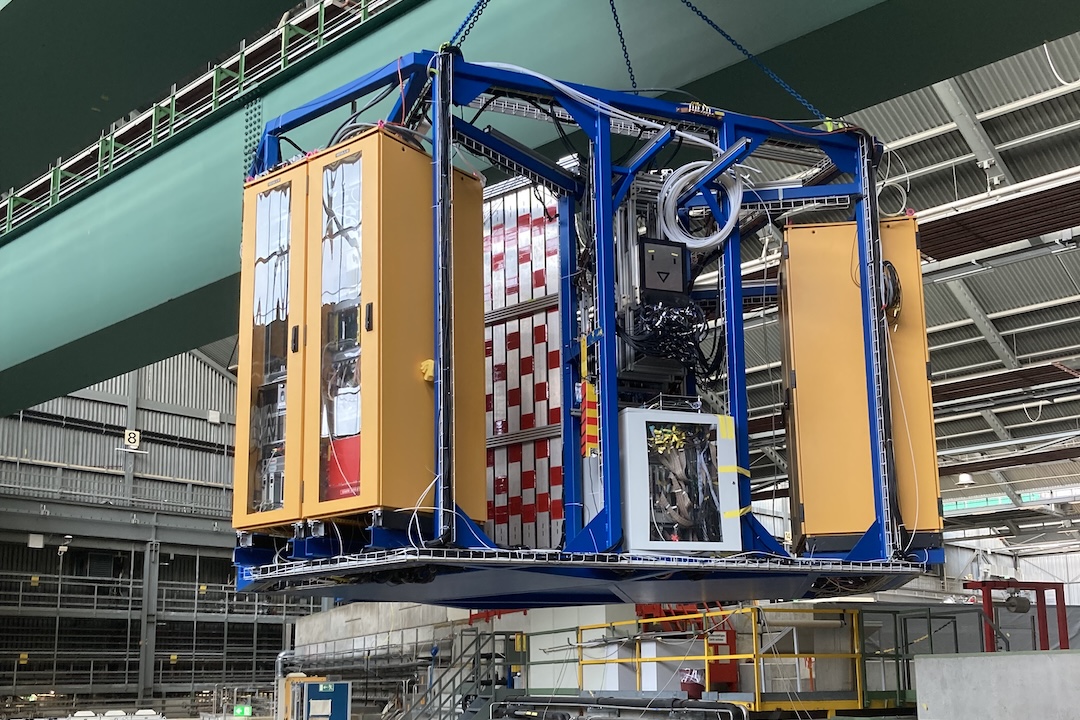
The MUSE instrument at PSI in Switzerland. (Credit: Evangeline Downie)
Driven largely by federal funding sources—the MUSE project is backed by funding from the National Science Foundation while Schmidt’s group is supported by a DOE grant—research at facilities like PSI and JLab also drives breakthroughs outside the lab.
Some are based directly on the knowledge obtained from the atom. Quantum computing codes, for example, are patterned on insights into the spin of nucleus particles. Others are inspired by the experiments themselves. Some childhood cancer treatments use the same proton accelerator techniques in MUSE to precisely target tumors with radiation. And the powerful magnets developed for JLab accelerators and detectors are the model for better, cheaper and more reliable magnets in semiconductors, MRIs and other technologies.
“Nuclear physics has been the launching point to develop better magnet technology,” Schmidt said. “It is not such a big stretch to go from a hospital MRI magnet to the big solenoidal magnet that encloses GlueX.”
Shift Work
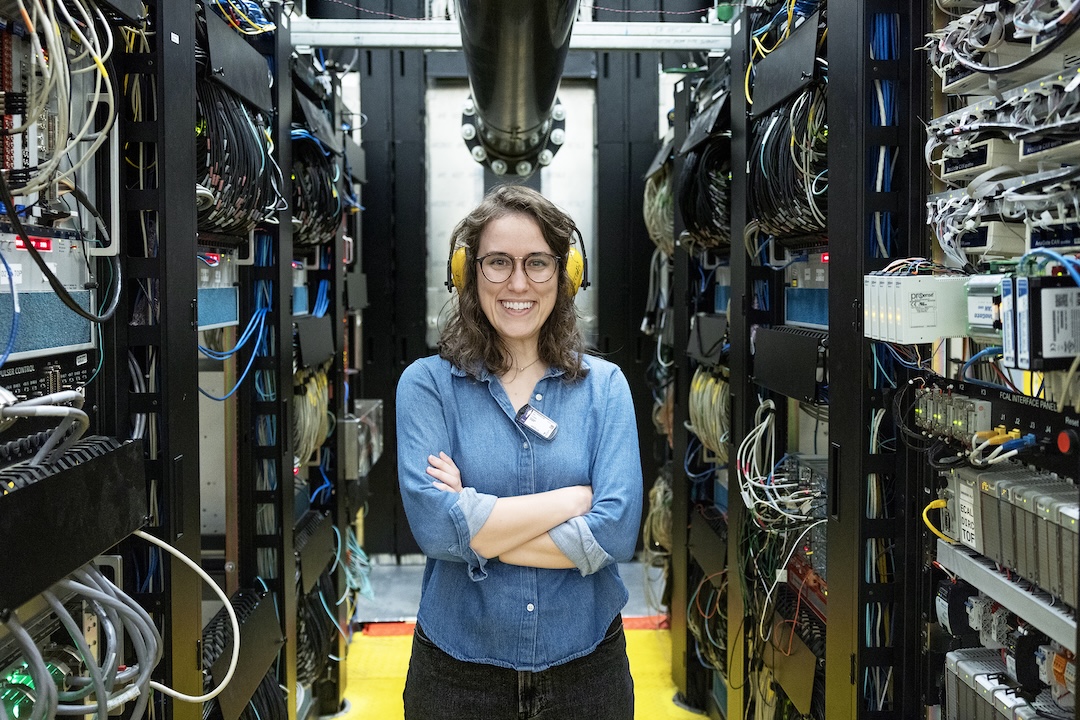
Back at JLab, Sharp checks in for another shift at the counting house. After working several midnight-to-8 a.m. watches, she now tries to schedule daytime hours. “I was nocturnal for a while—and it was not a fun time,” she laughed.
The counting houses are usually staffed 24/7, preferably with two-person crews. In their off-hours, students plot experimental data for their own thesis projects. On their eight-hour shifts, they step into the roles of scientists, engineers and mechanics—collecting data and overseeing experiments while fixing software bugs and troubleshooting hardware issues. “You definitely have to be a jack of all trades,” Ratvasky said.
As a shift leader, Sharp is responsible for everything from keeping the trillions of bytes of data scrolling to checking for blown fuses and loose cables in the hangar below. “We’re essentially babysitting multimillion-dollar experiments at all hours of the day,” she said. She’s even watching the weather. The detectors are highly sensitive to shifts in barometric pressure—and a summer thunderstorm can upset results. “It’s a Goldilocks situation,” she explained. “They can’t get too hot or too cold.”
Booking beamtime isn’t easy, with researchers from around the world competing for hall access. Experiment slots are often scheduled years in advance. When it’s their turn on the calendar, faculty and students uproot their lives for weeks- or even months-long stays in motel rooms or Ikea-decorated facility dorms. After winning a DOE fellowship, Sharp actually moved to Newport News to be closer to the JLab headquarters.
On a good shift, the weather cooperates, the beam runs smoothly and the detectors—“temperamental beasts,” Sharp calls them—never falter. On a bad shift, the blue rectangles on the warning screens turn red—signaling a problem. If a component short-circuits or a detector disc cracks, Sharp makes a late night call to JLab engineers for an after-hours fix. “I am often the bearer of bad news,” she said.
“We’re essentially babysitting multimillion-dollar experiments at all hours of the day”
Phoebe Sharp, M.S. ’22, M.Phil. ’23
(Credit: Jefferson Lab)
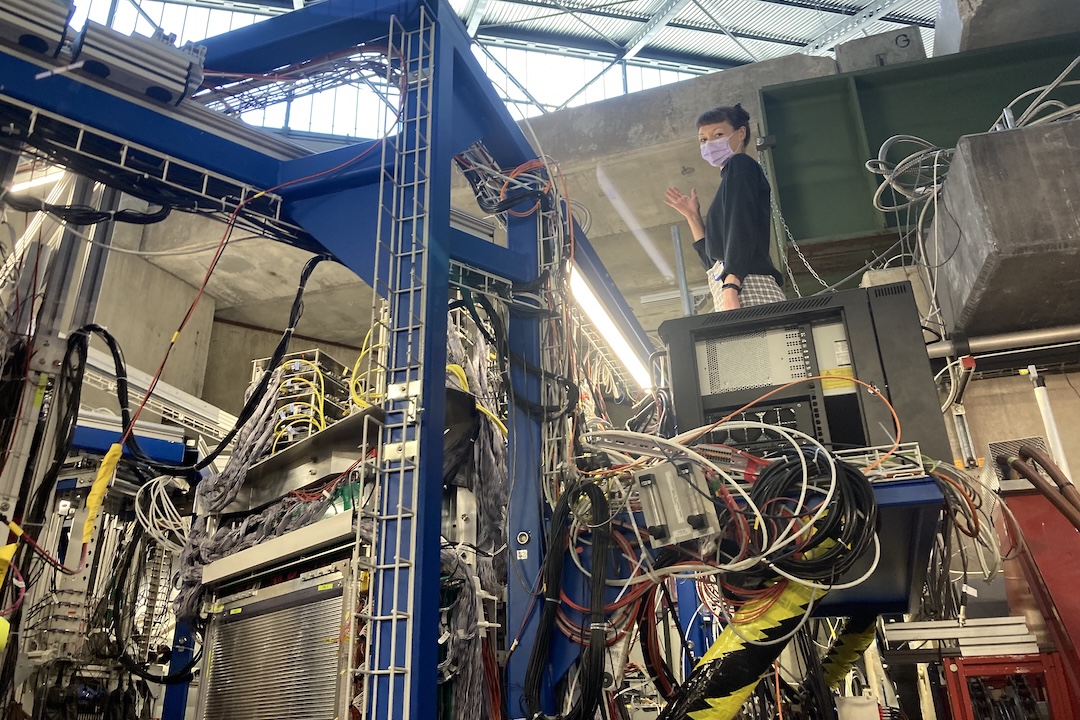
(Credit: Evangeline Downie)
9-to-5 Need Not Apply
At research hubs like JLab and PSI, “our students do basically everything,” Downie said. Indeed while patching detector leaks and draining dehumidifiers may not sound like real science, she emphasized that students are learning the day-to-day realities of a working physicist—while also filling their resumes with journal bylines and sought-after skill sets in project supervision and team management. “It’s very, very far from a 9-to-5 job,” Feldman said.
For a GlueX detector upgrade that Schmidt predicts will jolt his gluon experiments into a new phase, then-undergraduate Quinn Stefan, B.S. ’25, spent summer 2023 preparing 1,600 energy-absorbing crystal bricks that help the machine catch high-speed particles. During a two-month stint at JLab last summer, astrophysics senior Nippe-Jeakins helped complete the upgrade by stringing cables from the bricks to computer banks, sometimes pushing them with a broom handle under multiton detectors. “I’m not huge into instrumentation,” she laughed. “I kept thinking, ‘Please don’t let me break anything.’”
“I do love how one day you can be running simulations on particles that you can’t even touch—and the next you’re doing something super physical,” Stefan said. “There’s a connection between the physical instruments and the physics.”
And the scientists-in-training are also preparing for another reality about the world of experimental physics: They may not see the results of their research for years or even decades to come. The MUSE collaboration will collect data for five months in 2025, after taking 10 months of production data over the previous two years, and will take at least two more years to analyze it. And Schmidt said the full impact of his JLab work may not be felt for 50 years—if not longer.
“We’re still learning the rules of the game. The technology that comes out of this might be a long way away,” Schmidt said. Far from frustrated, however, Schmidt said he’s still inspired each time the accelerator fires. “These puzzles are confusing and mysterious and thrilling. We’re opening up new frontiers.”
Photography by William Atkins unless otherwise indicated.